
Vol. 5 No. 1 (2026): January to March
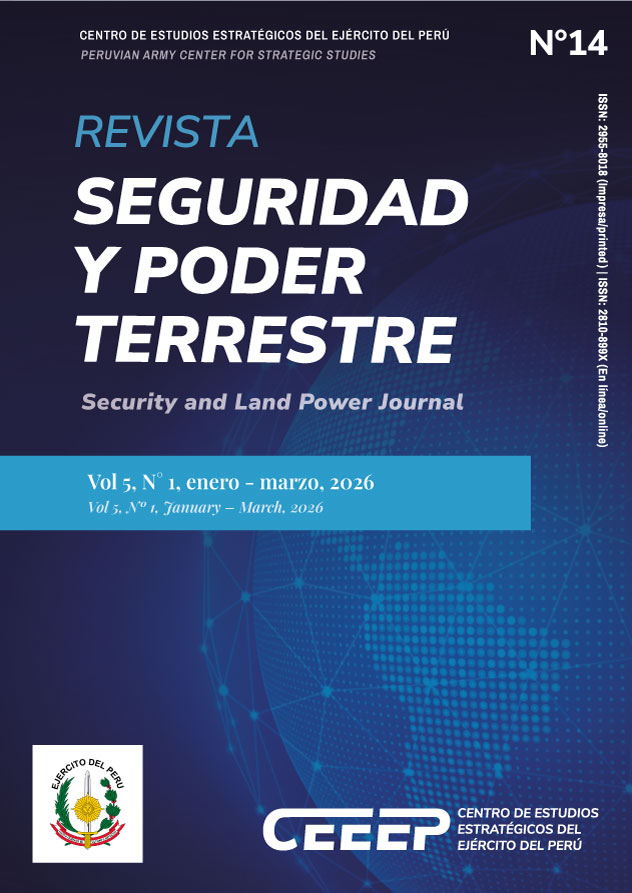
The Peruvian Army Center for Strategic Studies (CEEEP) presents the fourteenth edition of the journal Security and Land Power, an academic publication dedicated to disseminating original research related to security, defense, and contemporary strategic thought. In an international environment marked by the intensification of geopolitical competition, the transformation of conflicts, and the emergence of multidimensional threats, the production of strategic knowledge becomes a fundamental instrument for understanding the challenges faced by states and for guiding the formulation of public policies in the fields of security and defense.
From this perspective, the journal is conceived as a specialized space for reflection and analysis aimed at promoting academic debate on strategic issues that affect national security. The works included in this issue are aligned with the research lines that guide the academic work of the CEEEP—Strategic Assessment, Strategic Foresight, Strategic Art and Land Power, and Strategic Leadership and Institutional Management—which makes it possible to examine the phenomena addressed from a comprehensive perspective that articulates geopolitical, doctrinal, institutional, and public management approaches.
This edition brings together eight articles that analyze different aspects related to national security and the processes of institutional transformation of the Peruvian Army (EP). Each contribution addresses a specific strategic problem and provides analytical elements that enrich the understanding of contemporary challenges in the fields of security and defense.
The first article, “Corío and the Geopolitical Chessboard of the South Pacific in Scenarios of Systemic Competition and Strategic Sovereignty,” by Lieutenant Colonel Manolo Eduardo Villagra, examines the Corío port project as a strategic infrastructure with the potential to reshape Peru's geopolitical position in the South Pacific. The study evaluates different scenarios associated with the financing, governance, and development of the project, considering its implications for the country’s strategic autonomy, economic competitiveness, and national integration into global value chains.
The second article, “Citizenship in Peru as a Public Issue and Multisectoral National Policy: Impact on National Security and Defense,” by Brigadier General Emilio Jesús Cam Albújar, examines the weakening of civic culture as a factor affecting democratic governance and state security. Through an analytical-propositional approach, the work proposes the need to promote a multisectoral national policy aimed at strengthening social awareness, civic responsibility, and citizen participation, understood as essential foundations for institutional stability and national development.
The third article, “A Bilateral Military Planning Model for Security Cooperation between Peru and the United States,” by Lieutenant Colonel David Esteban Díaz Janampa, describes the mechanisms of military cooperation between the two countries and proposes a planning model that integrates the DOTMLPF-P framework with the functions of war, with the purpose of strengthening the sustainable development of military capabilities and contributing to the institutional transformation of the Peruvian Army.
The fourth article, “Operations ‘Chavín de Huántar’ and ‘Cerco’: Milestones of Military Victory against Terrorism,” by Major General Oscar Luis Calle Pérez and Lieutenant Colonel Manolo Eduardo Villagra, examines the strategic impact of these operations in the military defeat of the terrorist organizations that operated in Peru during the 1980s and 1990s. The study also explores the subsequent evolution of these threats, highlighting their transition toward unconventional forms of confrontation in the political, ideological, and narrative domains.
The fifth article, “Military Philosophy and the Moral Power of the Army as Pillars of Institutional Reengineering,” by Major General Oscar Luis Calle Pérez, reflects on the importance of military identity, organizational culture, and military values as essential foundations for the institutional transformation of the Peruvian Army. The author argues that institutional modernization should not be limited to the development of material capabilities but must instead be grounded in the strengthening of leadership, moral cohesion, and the doctrinal tradition that characterizes the military profession.
The sixth article, “Implementation of Process-Based Management and Its Relationship with Service Quality in the Major Service Units of the Peruvian Army,” by Lieutenant Colonel Roberto Carlos Alonso Tapia, presents a study on the process of institutional modernization from the perspective of public management. Through a quantitative approach, the research evaluates the relationship between the implementation of process management and improvements in service quality within Army support units, highlighting its importance in strengthening organizational efficiency and consolidating results-oriented institutional management.
The seventh article, “Special Forces and Their Employment in Information Operations,” by Brigadier General Augusto Álvarez Torres, examines the role of Special Forces in the contemporary informational domain. The study analyzes how these specialized units contribute to the development of information operations aimed at influencing perceptions, narratives, and decision-making processes, highlighting their importance in scenarios of hybrid conflict and strategic competition characterized by disputes in the cognitive and communicational domains.
The eighth article, “Beyond Management: Strategic Thinking as a Ethic of Conduct in Military,” by Major General (Ret.) Domingo Ricardo Bustamante Zúñiga, examines strategic thinking as an essential dimension of institutional leadership in defense organizations. The author analyzes the relationship between leadership, organizational culture, and strategic capability, and warns that certain institutional dynamics—such as the primacy of immediate management or the so-called “culture of urgency”—may weaken strategic reflection and limit long-term projection. In this sense, the study emphasizes the need to revalue strategic thinking as a permanent leadership practice aimed at strengthening the institutional capacity to anticipate scenarios and interpret the strategic environment.
Taken together, the studies included in this edition provide a broad and multidimensional perspective on contemporary security and defense challenges by integrating geopolitical analyses, assessments of international cooperation, doctrinal reflections, and contributions related to institutional management. In this way, the articles address issues arising both from the national sphere and within the international strategic environment, allowing them to be examined from a comprehensive perspective.
Published:
2026-04-17